Sea Dragons
Location: Found on most major coastal city zones.
Breeding centers include Telva and Aakal, both on Kiran. Any area with
a large lake can be the site of a Sea dragon, however they must either
be hatched near it or airlifted in, since they cannot move on land.
They have access to literally hundreds of miles of open ocean, and use
it with pleasure.
Physical: Huge and healthy, with the longest lifespan
expected of any dragons. Since they are always only found in the ocean
or large bodies of water, they can grow until they die, so they really
have no expected 'adult size'. Their strength is appropriate, in the
90 range most often. Their speed is surprising, within their watery
context, with a 95 average Reaction. As far as their perceptive abilities
go, they are average, having a Reaction/Perception with vision at about
80. They also have an electrical sense, which they normally only use
to detect their food, but can be trained to locate underwater alien
crafts. They have a good strong skin, like sharkskin, however they are
not really behemoths internally, and have a Body Type around 90 per
length, depending on their size. They are used only to disrupt alien
activity in the waters of Zekira.
Eggs: Sea dragons lay egg cases which greatly resemble
earthly shark eggs. Long and narrow, leathery and somewhat opaque but
translucent enough to detect life within. These eggs are usually laid
in or near a beach, where tides reach. The nest is usually very deep,
almost 2 lengths deep, so it is very unlikely that they will ever get
washed away. However, this makes Sea dragon birthing extremely difficult.
Far from being the shallow turtle-like nests of earth, the arm-length
hatchlings must dig through the sand (mostly packed) to reach the water.
Bred Sea dragons on the other hand, are always placed in a very well
protected and very easily observed area and kept at the proper temperature.
When hatching in clinical settings is ready, the eggs are actually moved
into proximity to the ocean or body of water. Females become fertile
once every three or four years.
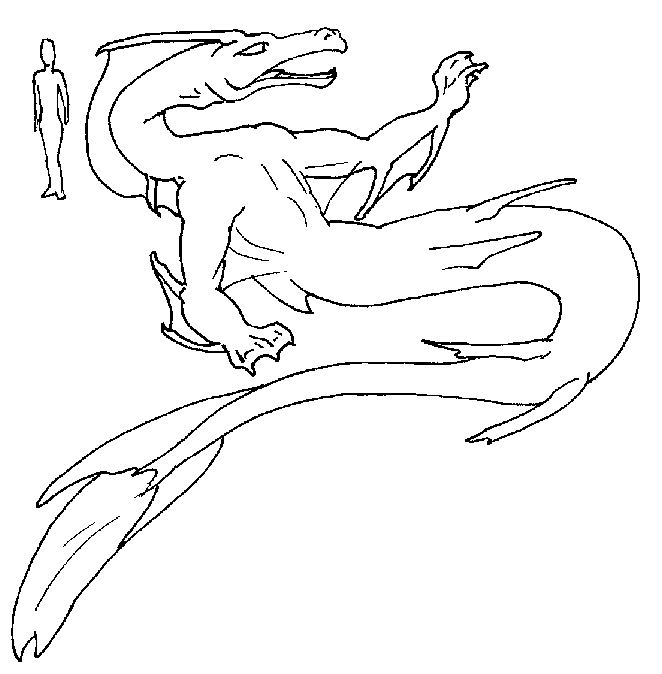
Basis and Description: One of the larger dragons,
Sea dragons are based upon the native 'sea dragon' and blended with
a large amount of Zekiran genetics. Their freshly hatched appearance
is that of a rather human looking fish-tailed baby. All right, one with
a very long neck and pointed face. And fins. They are known to get up
to 12 or more lengths, and are generally very sleek and aquadynamic.
Most of them have a long, strong tail, tipped with balancing fins. Their
back is graced with a fin as well, and their neck is often up to twice
the length of their head. They have what can only be described as a
torso, with arms that end in clawed webbed-fingered hands. These help
not only in their attacks but their swimming. These dragons are colorful
with patterns in blue, green and white, occasionally splashed with bright
reds and yellows. Some dragons grow webbing between their arms and body,
allowing them to reach into the air and glide for short distances as
a flying fish would.
Attacks: With their long, straight snout, they can
deliver a very hard bite, however they rely more on grasping their prey
with their hands and crushing it. The common attack shared by all Sea
dragons is a sonic attack, similar to a dolphin's echolocation blast.
With it, they can stun whole school of small fish, or even break seals
on armor or machinery. There is nothing to defend against this ability,
it is not a psionic power, it is a function of their vocal chords. Some
Sea dragons develop poison tips on their many fins, becoming dangerous
to brush up against.
Defenses: The best defense for a Sea dragon is the
ability to dive below the water and remain there for more than 5 hours
at a time. Their lung capacity if they are able to breathe in the air
is gigantic, and some of them cannot breathe air, meaning they spend
their entire life under the water. They can hit bottom, and do not seem
to suffer any side effects of deep water pressure. That alone usually
chases off pursuers, for their crafts are designed for zero pressure
and simple atmosphere work, not the crushing depths! Otherwise, they
rely on their coloration to blend in with local surroundings. Some rare
Sea dragons are able to change their coloration and texture similar
to an octopus would.
Mental and Psionic Abilities: With an almost Human
intelligence, averaging around 30, Sea dragons can communicate quickly
and usually do so with the aid of their wide vocal range. Rather like
dolphins, they chirp and squeek, and wail, and have low-frequency humming
along side ultra-high-frequency speech. Their empathy is low, giving
them the use of about 3 powers. Powers available to these dragons include
a wider power of electrical sense or control or even attack, further
detection and identification powers, the ability to use cold either
as an attack or be protected from serious cold temperatures, and rarely
they can control sea life.
Disadvantages: Apart from the fact that they cannot
be on land for any length of time, Sea dragons have several typical
disadvantages including the aggression toward other large animals or
dragons. They are territorial, but can be taught otherwise. Some 40%
of them cannot breathe air, and must never be expected to surface except
to view their Master above. Some others have a very short range on their
sonic ability, either because their vocalizations are weak, or they
cannot control them very well. They also may have skin shedding problems,
and if they become injured in the water they may attract the predators
of the oceans they protect.
Master and Breeder Expectations: Well. Everyone
knows that Zekirans don't swim very well if at all. So… Making
Sea dragons seemed to be kind of crazy at first. When the large enemy
installations in the remote parts of the oceans were discovered, however,
minds changed quickly. However it is absolutely necessary that a Sea
dragon Master must have ocean-going or at least water-safe powers and
mutations. Cold protection and pressure survival are also quite good.
But mainly the ability to swim without drowning is about it. Breeders
must always have a boat, and many smaller Dragon Breeders specializing
in Sea dragons have island homesteads.