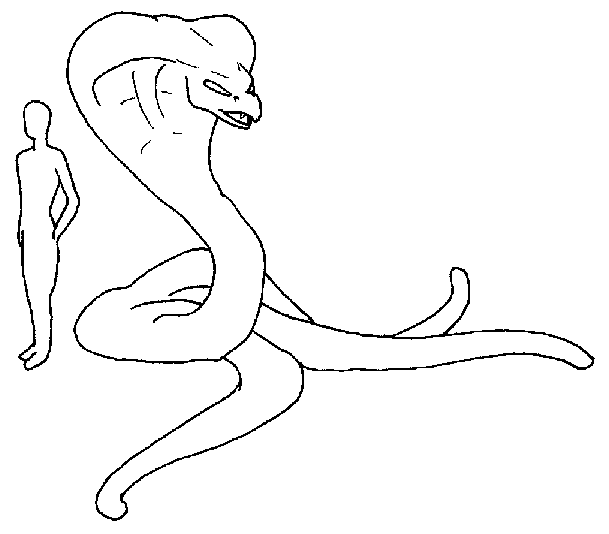
Desert Dragons
Location: Found primarily on Kiran, across the desert shared by all
three Areas. Major Breeding centers include T'dal and Reant.
Physical: They are suited to close range combat
and are considered an 'infantry' type dragon. Because of their small
size, and their genetic background, they are usually gone through quickly
and should not be gotten attached to for any length of time. Their lifespan
is approximately 20 years. Their low mental abilities are balanced by
their very compact size and their disproportionate strength. Though
they only range from human sized to about 3x human, their strength is
often equatable to 70-80 Zekiran Strength! They are all muscle. They
are fairly durable, with a Body Type of around 90 average per Length.
Their small size and physical make up means that Desert dragons are
very fast when they need to be. Their speed equates to an average of
95 Reaction.
Eggs: Desert dragon eggs are relatively soft, and
very small comparatively. They are pale tan in color and almost totally
round. The female will dig out a shallow nest bowl, lay her eggs, and
occasionally bury them again. She visits but infrequently, and there
are many more Desert dragons out there than most people realize because
sometimes they just abandon them. While the eggs may still hatch, depending
on their location and surroundings, they may mature into wild dragons.
Females come into fertility about once every half year, and if they
have born a nest of eggs, they will wait one full year.
Basis and Description: Their genes are based on
cobra-like snakes. Their skin is a scaley, flexible type, and is colored
with browns, reds and yellows, often with striking patterns on their
back and pale on their bellies. Many of them have multiple tails, and
typically they have a cobra-like hood on their neck which fans out when
they are attacking or feeling distressed. They have a very small head,
comparatively speaking, with a sharp muzzle and dangerously sharp but
very short fangs. Some of the Desert dragons have a poison bite, while
others use their tails to constrict their opponents. A semi-common mutation
is that of a "hydra", with not only multiple tails, but up
to 4 heads!
Attacks: The attack which all Desert dragons share
is that of hypnotic power. With their hood spread and their shifting
tails, they ensnare their opponent with a psionic hypnosis that acts
rather like the Zekiran power of Mind Numb while they are concentrating
on it. Once this concentration is broken, the opponent will come out
of the hypnosis, but by then the other Dragons around should have taken
care of them… or the Master has done so.
Defenses: A main defense is their ability to bury
themselves into the sands of the desert and lay in wait for their enemies.
Even expert eyes might miss a Desert dragon when they want to remain
hidden.
Mental and Psionic Abilities: Most Desert dragons
are of a medium animal intelligence, equating to a Zekiran score of
about 11-25 Intelligence. They can think clearly, however most of the
time they are thinking about what to watch next or which rock is best
to bask on. They are simple minded, and fairly aggressive. Their empathic
ability is very low, equating normally to the use of 2 Zekiran type
powers. Among the powers they have, however, they are very adept and
when trained at a young age, they can do some amazing things. Empathy,
fear control, invisibility, control over heat (not fire), invisibility
and surprisingly enough psychometry are among their main powers.
Disadvantages: Desert dragons are never expected
to fight machines. They obviously have no effect on creatures when they
are farther away than about 10 Spans, so they are very close-range indeed.
Since they rely on their hypnotic powers, they must encounter an alien
at least once before going into combat, so they can be trained to use
the power on only the enemy. Their perception is fairly limited, their
vision being based on movement and heat sources. Though they can see
into the infrared spectrum, their sense of smell is far better than
their weak eyes. A waving tongue is always seen, and if they lose it,
they are effectively done for in combat. A common disadvantage among
Desert dragons is the requirement for warmth. Above and beyond that
of needing heat to digest, some Desert dragons need a long warm-up period
before they are able and willing to go out into combat or training.
Usually those dragons do not have the heat control power. They are also
remarkably aggressive, an equatable 110 on the Zekiran scale. When they
are used together, or trained from youth with other Desert dragons,
they operate as a team, but if this training does not come when they
are very young, or they have difficulty with another of the dragons
in their team, they will fight - often to the death.
Master and Breeder Expectations: Breeders of Desert
dragons have attempted to balance the aggression with some kind of cutoff,
that being their small size. A much larger dragon with that type of
aggression problem would be a danger to far more than the enemy. Coloration
is never altered, for their stealth relies upon natural patterns. Masters
of Desert dragons must be able to withstand the heat of the desert -
all the time. They are also required to be patient. Desert dragons are
certainly not the easiest dragons to work with under any circumstances,
and they sleep a lot when not needed in combat. Other activities for
Masters of Desert dragons should be quickly accessable, because once
that dragon falls asleep it'll be a while before they wake up.