
Page last updated 2.9.26 changing some info, reformatting, images
Kthari
Mahar Information
K’thari are found on three out of the four habitable moons of the gas giant Mahar, which is near the old galactic core near Fresia but not so near it that the Metellos trade route kept it in long-term use. The system was a spot dominated by scientists, scholars and artists thousands of years past, but now (BBY 20-ABY 20) largely ignored or only barely in the process of repopulation by off-worlders. This planet and its moons have gone downhill since before the Clone wars, at which point apparently most of those scientists went into exile.
The planet itself is quite large, and though there are gasses roiling around that might be worth siphoning off, it is far too turbulent to do so safely. One moon is entirely barren and without an atmosphere, but can be mined for what is left of its exotic minerals, and is primarly why anyone has rediscovered the area at all. Two of the three terrestrial moons are hilly temperate forest and jungle (1), tropical woodlands with swamplands and river systems (2), while the third is dominated by craggy mountains, scrub deserts and extreme temperatures at the poles, but with a small belt of tropical islands.
On this third moon also are the largest ruins of cities, and archaelogists drool over them. Most K’thari keep clear of the ruins, religiously. There are obvious old spaceports and shipyards, but the fact that they are not necessarily deep-space-faring in this current era tends to make biologists and archaeologists believe they were either seeded on those other worlds, or have been isolated only recently after having been space-worthy once. The Kthari have existed there at least five thousand years, but their lifespans seem long enough that that isn't all that many of their generations. Their population is quite small compared to other worlds similar to theirs. They still all speak approximately the same dialects of Galactic Basic, with some local distinctions even across the different moons. When distant and isolated tribals are asked whether they know of their counterparts on the moons above, they will generally nod but not elaborate on how or why they know. Obviously with closer Galactic contacts occurring, this generation have much more information and technology available than they had for at least a thousand years before.
It is unknown who engineered this species, but it was likely that they arose artificially since their human aspects greatly resemble those racial attributes normally found in standard Humanity. They cannot interbreed with humans or humanoids without assistance, but they can be most easily engineered or test-tube spliced. Their presence on the distant system long since forgotten by the mainstream Galaxy seems to indicate that Kaminoans were responsible, but there are no clear signs of that species' distinct architecture anywhere on the three inhabited moons. Perhaps if archaeologists dug a little deeper they might find more... And also discover the methods the Kthari used in the distant past to communicate or even travel to those other Moons. Those ruins and structures do still function but they have been forbidden from approach for generations now, and have fallen into disrepair, some forgotten by those who have never even learned of their existence.
While the moons are well stocked with animal life, there is no evidence of any sapient life forms beyond those who had built the most-ancient of ruins, and those who were clearly Galactic explorers and scientists. Each moon sports different prey, predators, availability of safe water and food plants, and as such eash group of Kthari who reside on them has slightly different expectations of hunting parties or where to bed down for the night. The radiation from Mahar is strong enough that it doesn't take sun exposure to feel warm, and even on the 'night' sides of each moon, there is always a softly violet-colored glow coming from Mahar.
The image below is in scale but not for distances. Mahar 4 is the closest to the planet, and likely why its surface is currently barren. 1, 2, and 3 vary only slightly from the 'sweet spot' of orbit around the gas giant, but do have variations in their plane of orbit causing them to experience interesting varieties of eclipses. The moons are easily visible in the daytime skies when they are near enough, and clearly reflect their colorations at night.

Race Information
K’thari or Kthari; the ' is optional but usually indicates a short pause between syllables (and for those who can’t pronounce a short kh-th -- just ‘Thari, like a lisped sorry). The term Tribe serves two definitions - the physiological Tribe, a species-breed based on wing size and type, and the Tribe of a group of Kthari living near one another.
Physical Height and Build
K'thari are quite tall and can appear menacing at maturity, however they are generally speaking hollow-boned, and as they descend from flighted species their weight doesn't appear to match with that height at times; those with leather wings tend to run much heavier than their feather-winged counterparts and the condition of their bones for this reason are thicker the smaller the wings get; however the larger wing types leads to their being 'careful' when attempting to fly. Usually only the youngest or most slight in build are able to learn to fly well enough not to just break themselves on landing.
Male Immature to 6’, to 250#;
Male Adult 6’5” - 7’8”, to 400#
Female Immature to 5’8”, to 250#;
Female Adult 6’2” - 7’5”, to 360#
Body Composition
K’thari are bipedal Humanoids with a strange mixture of feline,
human and avian features. They are warm-blooded mammals with a single four valved heart, giving live-birth. They have a total of eight limbs plus a tail
(used mainly for balance) -- two legs (the mostly-human feature beyond their faces), four arms (two of avian and two of feline variety), and two
wings (see below). The shoulder and back joints of the K’thari are
intriguing at best, downright amazing at worst (imagine a three way joint?).
They are towering and usually slender in build. Their bodies and legs
are usually covered with a sparse human-like hair, in complimentary colors
to their personal scheme (see below), with more furlike down covering
their lower legs, absent on the feet. There is usually a stripe of fur
leading down their neck to the tail and rump area. Their torsos are only a little longer in proportion to Humanoid races, and females have only two breasts (unlike some other multi-limbed species which have pairs according to their arm quantities). Skin tone varies by
tribe and has some amount of dominance of one over another for inheritance, but with interbreeding being common the standard tone will
be a warm brown and is modified by exposure to elements beyond just sunlight given the presence of Mahar as a gas giant and bearing a radiation field. Hair color varies with human racial features (from white-silver
to black, red, browns and blonds) and of course can be dyed. Eye colors
are seemingly attached to Avian features -- see below. Tail color is often
the same shade as the wing arm and spinal fur with a tuft at the end that might be darker, lighter, or completely different from their head hair. While
the females are slightly smaller they also are slightly more agile and
while few tribes are actually able to fly, those most likely to be able
to will be female because of their smaller weight.
Lifespan and Maturation
They live to aproximately 200 years, some individuals have been recorded at over 250. Females become fertile at about age 25, but before then begin gaining their secondary sex characteristics of full colorations and body size. Males experience puberty at age 25-30, so it is not uncommon for females to look for much older mates. Gestation is approximately 13 months, and conception is usually following a week-long ‘heat’ during which the female is much more eager than usual for interaction. Female fertility continues generally until death, but some have begun to experience menopause around 20 years before then. Most births are single young, but depending on the tribe twins (maternal or fraternal) are common or the norm. (The non-human influence of ‘litters’ and ‘broods’ affects this, apparently.) A female may have four to eight children in her lifetime, but usually one or two pregnancies is average, they concentrate on quality rather than quantity of family size, and aren't particularly attached after the young are mature, though they do not inbreed as a conscious social decision (or perhaps an unconscious one, designed by their original creators to prevent issues?).Taking care of the children is done by both parents for the first 12 or so years, then depending on the presence of skills, intelligence, or desire they are often handed off to a craft or the Shaman. It is extremely rare if not unheard of for a female to be forced into pregnancy before she is relieved of her child-rearing duties. Pregnancy cannot occur during the ten years following the birth, at any rate. They are considered ‘mature’ at around age 40, and continues with the maximum physical abilities until around age 185 (given average lifespan of 200), after which the body begins to fail, fur and scales begin to fall out, feathers rot or are not replaced after a molt, vision and hearing fail, and finally internal organs cease functioning. Most K’thari do not die of natural causes however, as there are still plenty of ways to become injured on these Moons.
There are three distinct subraces of K’thari: Humanoid (the most numerous), Leonid (the uncommon race), and Avian (the rarest). Humanoid individuals outnumber the other two subraces by three to one, and the Leonid outnumber the Avian by five to one. That all said, their population is extremely low across not only the Moons of Mahar but the Galaxy at large. Tribes that reside near spaceport ruins or other cities as observers may be quite large but sprawling, at up to 100 individuals at the core area, and over a thousand spread out for many square miles. Each pocket of a subtribe tends to live in family groups clustered in tree or cavern homes, and usually their territory is over 3000 square miles, loosely protected by scouts and protectors that have outposts fit for three or four inhabitants at a time. An estimate at BBY0 would run their full population at less than 2 million individuals.Cultural Organization
They have a tribal stratus consisting of a chief and their elder council, shaman (healers, specifically), guardians, and the whole rest of the tribe. Generally speaking the Chief status is given to whoever seems to fit the bill for the current crisis, and after that the tribe loosens again and goes on with whatever it was doing before. The Elder Council often consists of 'do they care enough to speak up', and more often than not the council will just issue whatever day to day orders are needed. The Shamans serve an interesting role in larger or more urban tribes, since they not only have knowledge of healing and health practices, but sometimes access to offworld technology or information. They often have at least one apprentice to their craft with them, selected from whoever seems to have the desire and ability to learn it. However they also may serve as translators, portent-reading astrologers (they do notice all the ships coming and going, they're not savages after all...) as well as those who warn against entering forbidden places. The Guardians within the tribe can be serve as warriors, scouts, weaponsmiths, and in rare cases armorers. They take orders either from the council and chief, or the shaman, depending on the mood and overall sensibilities of the tribe. The rest of the tribe usually serves in whatever capacity they feel like: hunting and gathering is common for younger kids as well as attending parents until everyone is ready to split up again. Home weavers and carvers, leatherworkers, even some glass makers and metal workers and the like are all found on each Moon, though with more or less emphasis depending on the climates.
There is no sexism in their culture whatsoever, they have had equal numbers of female and male leaders, shaman, and guardians their entire history. K'thari do not 'marry' but they may record their partnerships in their formal clothing or traditional arts. They speak a variant on Basic which involves some slurred purring noises, chirrups, and whistles. You will notice a number of names with an elide, ' in the middle or after the first letter. This is a cultural sound, a gap between syllables, and is not particularly indicative of any formal naming system. Body language features prominently, as well -- wing position, tail lashing, arm placement. They keep written records in rarely-learned Aurabesh and can read Galactic Basic, but also seem to know several older scripts found among the ruins, depending on proximity and Moon location. Mainly their 'records' are a personalized set of trophies, kept on their person and indicating 'wealth'. Anything from the skull or fang of the first animal they killed being woven through the leather of their formal outfit, to rings and circuitry they've found in forbidden dig sites... Whatever an individual feels is 'them', is kept in this manner. Related individuals often have tokens of their lineages, woven into wall hangings similarly, and made at birth for the children.
On that note: yes they do wear clothing similar to any given Humanoid type, though many choose to have looser fitting halter tops and skirts or long tunics. Those pictured usually are in 'Imperial Provided' gear, more because humans showing up tend to influence trends in that manner.
The disparate tribal groups meet only occasionally, but usually on a friendly basis. Though some amount of friction might occur at the borders between large tribes if there is a drought or natural disaster leading to less available food, for the most part they do not make war on one another and may settle disputes using their complicated martial arts practices. Most tribes have slight variations on this art, since some have much more dangerous equipment with which to gouge out eyes or a much wider reach for their wingsnaps. Offworlders who have seen Kthari fight are uniformly impressed and intimidated, as it's no laughing matter if you don't have a ranged weapon to stop them from going after you. They do not have any organized militia but they do use offworld or long-dusty technology for formal defense: they have cannons, they have blasters and bowcasters, but they usually reserve those things for defense versus offworlders. Mainly their weaponry is 'their own biology', but they use machetes and knives, spears, nets, and lassos or bolos quite frequently to hunt or guard.
The best way to describe K’thari galactic politics is 'apathetic'. Having been isolated this long, and with such a small population not 'worthy' of being introduced to the Galactic Senate (or perhaps prevented from?) the overwhelming majority of Kthari just don't care what is going on outside their moons. The presence of Imperial and Rebel activity on their moons has reignited many old talking points, however: for quite a while the Shamans have guarded their worlds' secrets and kept the tribes alternately in the dark or well informed about the rest of the Galaxy. There have always been scattered instances of offworlders landing and trading, hiring a Kthari as a bodyguard or crewmate, occasionally taking Kthari young as slaves, or stealing important but dusty artifacts from the ruins - all of which tends to make folks nervous about those people from the sky.
But now the Galaxy is here again, and a great many younger Kthari are interested in leaving Mahar to explore or seek their fortunes. At the current pace of this leave-taking it will eventually splinter the tribes and cause a complete loss of social identity, perhaps within a thousand years. (Remember that that is only seven to nine generations!) If things go badly however, it might be much sooner than anyone expects.
The effects of the Empire on their world has been strong, and -- when participating in the debate, which seems to be only about 1/4 of the population -- K’thari are equally as likely to become Rebels as Imperial subjects. Their worlds are being ‘colonized’ by both, so exposure has definitely begun. Fortunately for them, the worlds are old, worn out, and mostly useless for Imperial purposes -- they’re not interested in the ruins, and the natural resources of the inhabited moons have mainly been plundered already. The Rebel forces find the ruins to be the best bet for old relics, educational tools, and Jedi heirlooms.
Force Sensitivity
K'thari are overall only marginally sensitive to the Force. However they may discover talents hidden in their family lines: telekinesis in some fliers, long distance telepathy in some scouts, generally senses and communication seem likely. Shamans are often gifted with much more of this, and in very rare cases, might be strong enough to have pinged the Jedi seekers. There are a total of three K'thari listed in the old Jedi records - but after the Empire began it's highly likely those are now molten slag below the Temple on Coruscant. There are many old Temples on the moons of Mahar, however. Very old, very deep, or extremely well hidden ones. Those offworlders who are drawn to the system might discover far more hidden spots, ones which you can't pursuade most Kthari to enter just because of claustrophobia.
Should a new Force-sensitive Kthari mature near one of those sites, they may find themselves inerxorably drawn toward finding tools and holocrons, exploring those ruins even to the distress or outrage of their tribal Shaman. In the long run, however, those instances will be so rare that perhaps those Shamans should just shut up and let the new Force weilder learn... Whether they learn Jedi tactics or Ancient Sith ones, who knows - both kind of temples exist, and in fact many truly ancient ones, ethnic Sith rather than current ones, can be found on Mahar 3.
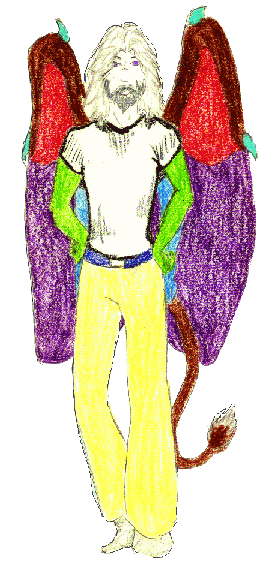
GENERAL ANATOMY
Head - generally human-appearing with forward facing eyes, a nose and mouth, hair; some exhibit longer or pointed ears or may have sharp canine teeth; both male and female might have facial hair depending on breed
Wing Hooks -- on most breeds two, four on Aich’i and Ahalo, and none on Seslen. Anatomically speaking the 'wrist' hook is actually a thumb nail, while the second hook is a 'finger' nail, all of the bones in their wing arms can 'kinda-sorta' be seen in medical scans, but they are usually fused into these shapes
Wing Types – Feathered (on Seslen, Ahalo and Aphern main breeds, partial on Heli and Apthi, and on all Avian tribes), or Leathery (on Aich’i, Chiroko and Daioko main breeds, partial on Heli and Apthi, and on all Leonid tribes)
Body Types – humanoid body with a slender frame on long-winged tribes, stockier on shorter winged (in general); hollow-boned trait runs from very light to hardly hollow in that order as well
Arms – One pair distinctly avian (scaled skin with talon fingers) and one pair distinctly feline (furry skin and stubby fingers with claws)
Wing Size – varies per Tribe and Breed, from too small to glide, to true flight capable
Tail – is uniformly feline in shape but with Tribal differences in tip (feathers vs fur)
Legs and Feet - Some K’thari wear shoes and some do not, depending on how much contact with humans and other spacefaring societies they have individually encountered. Legs are human-type though their toes might look more paw- or talon-like, and lower legs often have thicker 'hair' than humans'